Why Your Body Keeps Score at 3 AM
You already know the jolt.
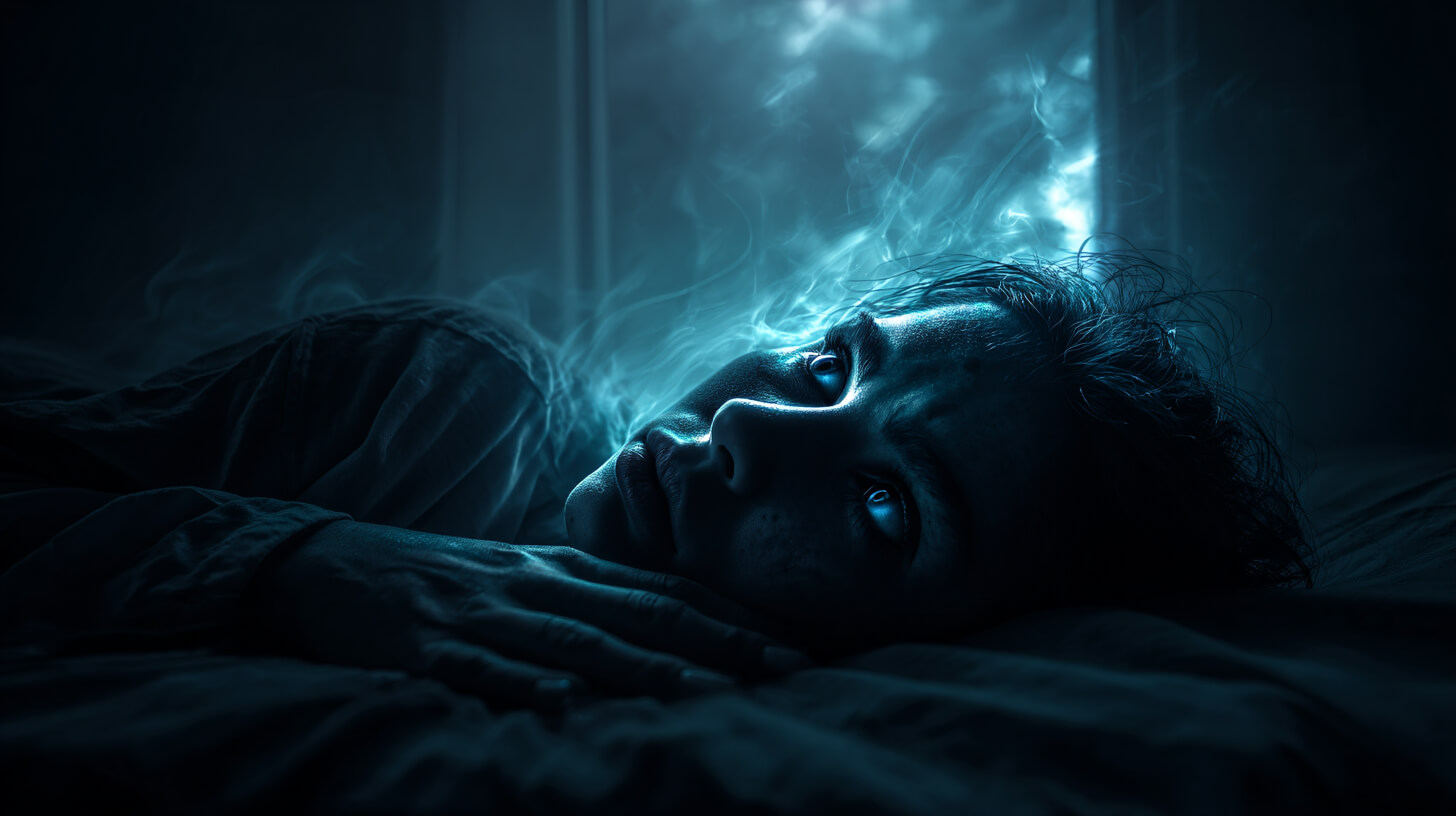
The snapping awake. The racing heart. The room scanning for something that isn't there.
But that's not the part that gets you. Not really. You can handle a racing heart. You can handle being startled. What you can't handle is what comes next.
The thoughts.
Not random thoughts. Not new thoughts. The same thoughts. The same wound. The same shame. The same regret. The same conversation you replayed a hundred times. The same mistake you thought you'd buried. The same fear that sits in the same place in your chest every single time, as it lives there.
You could set a clock by it.
3 AM. Eyes open. And there it is. Waiting. Like it never left.
And the thing that really messes with you, the thing nobody talks about, is how true it feels. During the day, you can manage it. You can contextualize. You can tell yourself "that was years ago," or "I've dealt with that," or "it's not as bad as it feels." And it works. Sort of.
But at 3 AM? Those same words mean nothing. The pain is louder than any thought you can throw at it. The shame is absolute. The dread is so physical it feels like gravity doubled.
You've probably asked yourself the obvious question. Why? Why is it always the same wound? Why does it always feel more real at night? And why can't I think my way out of it?
The research points to a surprising answer. You may not be able to think your way out of it because the part of your brain responsible for rational thought appears to functionally disconnect from the part that generates emotion. And because the wound you keep returning to may never have been stored as a thought in the first place.
It may have been stored in your body.
And that changes everything.
The Stranger in Your Skull
Here's something most people will never be told.
The brain you're using at 3 AM is not the brain you use during the day. It looks the same. It feels like yours. But structurally, functionally, it appears to operate as a different machine.
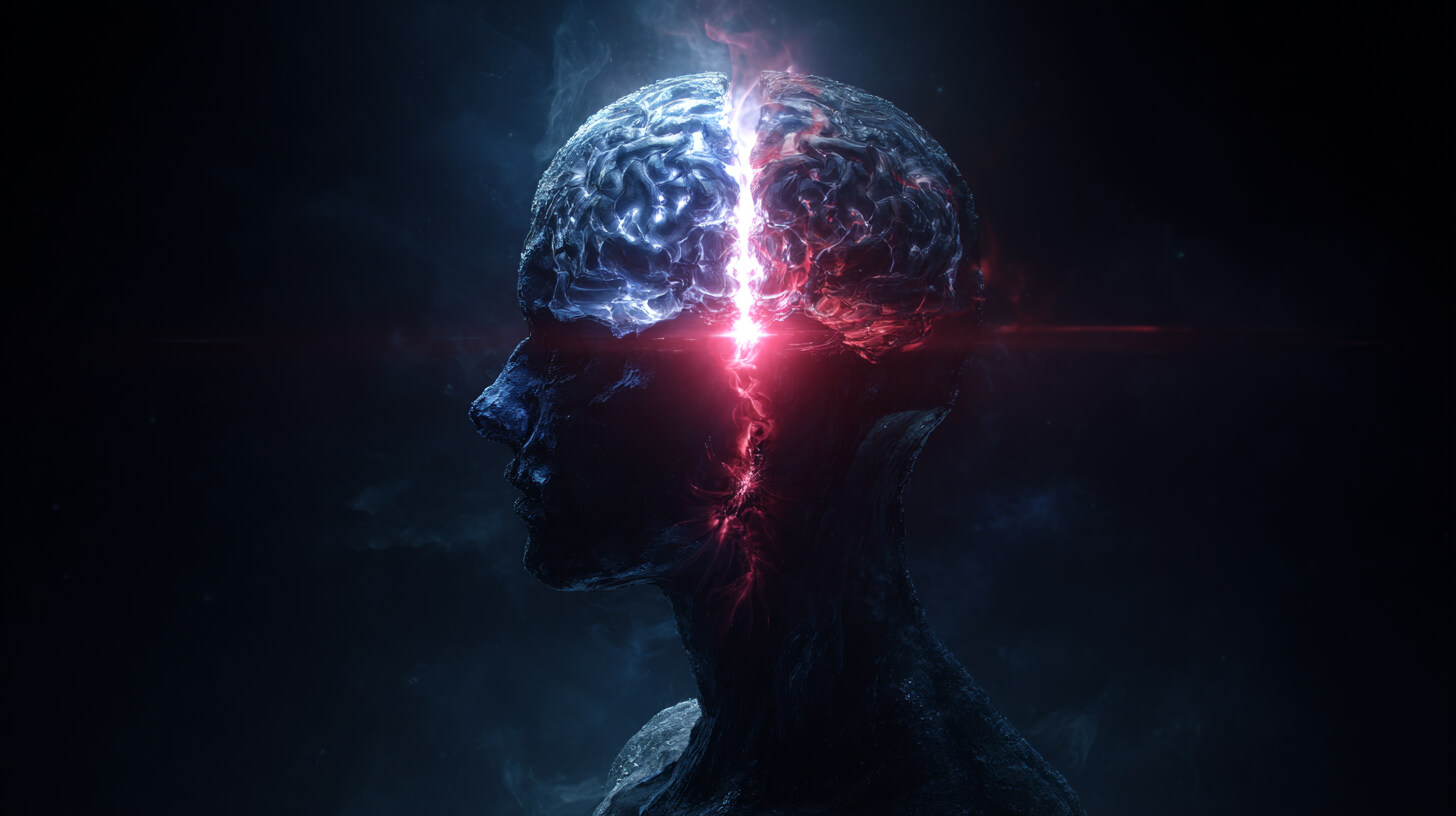
During the day, you have access to something neuroscientists call the medial prefrontal cortex. Think of it as the rational narrator of your life. It's the part of your brain that holds perspective. That says "yes, this is painful, but it happened a long time ago." That can zoom out. Compare. Weigh evidence. Regulate the alarm bells coming from deeper, older parts of the brain.
But the prefrontal cortex is one of the most energy-hungry structures in your entire body. And by the middle of the night, after hours of processing, repair, and metabolic drain, it starts to go dark. Not slowly. Not like a dimmer switch. Researchers describe it as a functional decoupling, a significant weakening of the connection between your rational brain and your emotional brain.
The data on this is remarkable. A landmark fMRI study published by Yoo and colleagues found that a single night of poor sleep triggered a roughly 60 percent increase in amygdala reactivity, the brain's threat-detection center. Sixty percent. That's not a subtle shift. That's an alarm system operating at a volume it was never designed to sustain.
And here's what makes it worse. Without the prefrontal cortex fully online to provide context and regulation, research indicates the amygdala loses much of its ability to discriminate. It appears to struggle to distinguish between a genuine threat and a neutral stimulus. It begins treating everything, a memory, a sensation, the sound of your own heartbeat, as potential evidence of danger.
Researchers have called this phenomenon "the Mind After Midnight." The hypothesis, proposed by a team at the University of Arizona, suggests that nocturnal wakefulness fundamentally alters cognition and behavior. During the biological night, particularly between 1 AM and 4 AM, the human circadian rhythm reaches its lowest point for positive mood and its highest point for negative mood. The brain's capacity for rational decision-making and emotional regulation appears to diminish so severely that scientists have described it as a window in which "reason sleeps."
So there you are. 3 AM. Heart pounding. And the only brain you appear to have access to is one that is primed to see threats in everything and has significantly reduced capacity to reassure you that you're safe.
That's why 3 AM thoughts feel different from daytime thoughts. It's not the same operating state. You're not being dramatic. You're not weak. Research suggests you are working with a brain that has substantially reduced access to a rational perspective at that hour. And the darkest thoughts you've ever had arrived in a window where the part of your brain that could have challenged them was largely offline.
But that only explains the volume. It doesn't explain the channel.
Why is it always the same wound?
The Archive in Your Tissue
There's a phrase in trauma research that has crossed into popular language, so thoroughly that it's almost lost its weight. "The body keeps the score." People say it casually now. In therapy sessions, on social media, in book club conversations. But very few people understand what it might mean mechanically. What researchers believe may actually be happening in the tissue when we say the body "remembers."
Here's what the research suggests.
When you experience something overwhelming, a trauma, a sustained period of stress, or a moment where the threat exceeded your capacity to process it, your brain may not store it the way it stores a normal memory. Normal memories get processed through the hippocampus, which acts as a kind of librarian. It tags the experience with a time, a place, a context. It files it into your biography. It gives it a beginning and an end.
But during extreme stress, cortisol floods the system, and research indicates the hippocampus can become suppressed. It goes partially offline. The amygdala, meanwhile, appears to go into overdrive, encoding the emotional and sensory dimensions of the experience with extraordinary intensity. The result, according to researchers like Bessel van der Kolk, is a memory that was never properly filed. It has no timestamp. No narrative arc. No beginning and no end. It exists as a collection of sensory fragments. A body sensation. A feeling of dread. A tightness in the chest. A specific kind of shame. Floating in the nervous system without a story attached.
This is what researchers call implicit memory. You don't recall it the way you recall your tenth birthday. You don't access it with words. You feel it. Suddenly and without context. Like it's happening now. Because, as far as your nervous system is concerned, it may be. It was never filed as "past." It may still be open.
And the body appears to hold it in more places than we once thought.
Not just in the brain. Possibly in the muscle. In the fascia. In the tissue itself.
This is the part that surprises most people when they encounter it.
Your body is wrapped in a continuous web of connective tissue called fascia. It surrounds every muscle, every organ, every nerve. It's one of the most densely innervated sensory systems in the body, packed with nerve endings that feed directly into the parts of the brain responsible for interoception, your sense of what's happening inside you.
When you experience a threatening event, your body braces. Your muscles tighten. Your shoulders hunch. Your jaw clenches. That's a survival response. That's supposed to be temporary. But emerging research suggests that when the event is overwhelming or sustained, or when the body never gets the chance to fully discharge the response, something may happen at the cellular level.
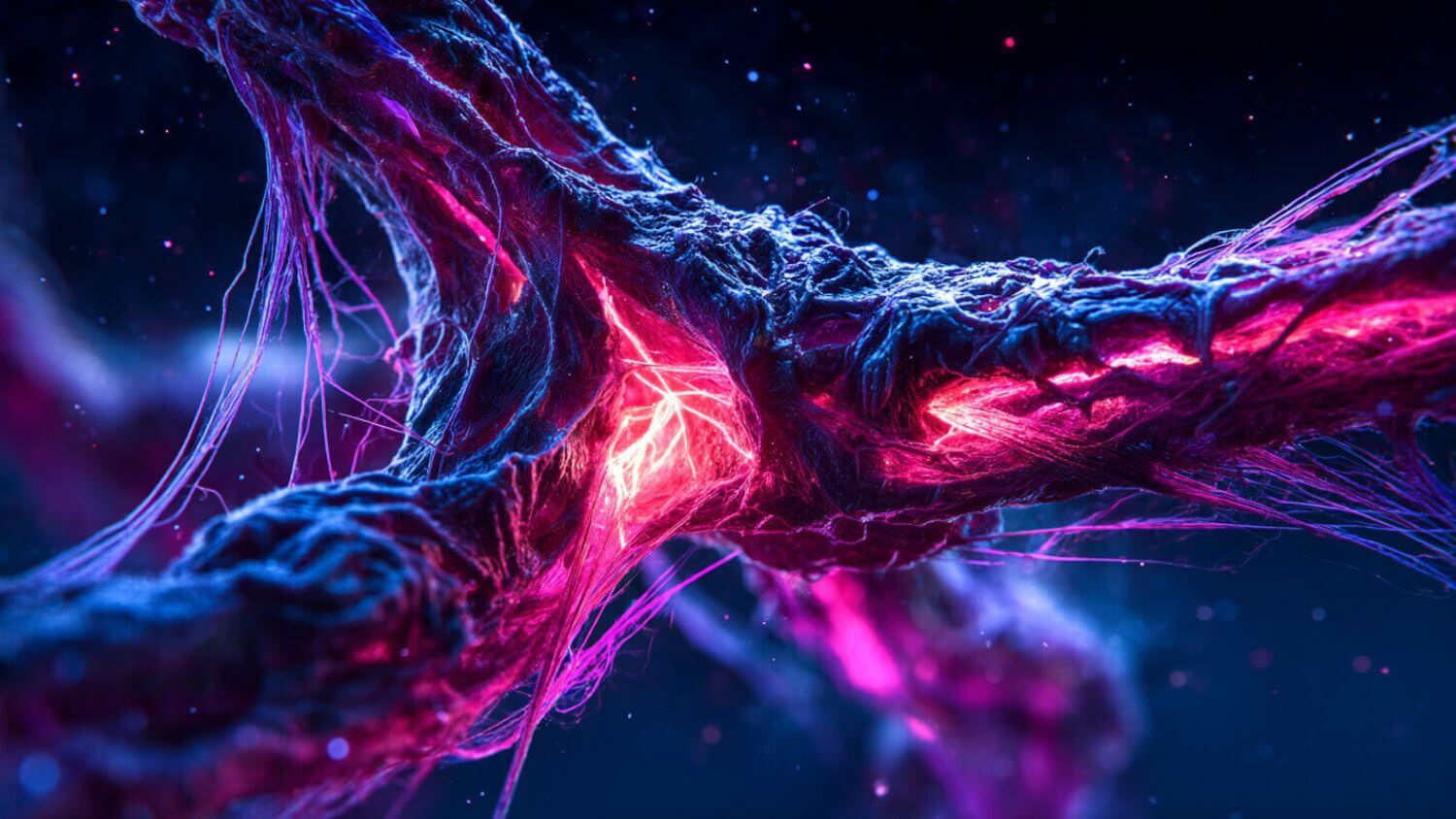
Studies have shown that fibroblasts in fascia, the cells responsible for maintaining and remodeling connective tissue, can sense mechanical stress and begin to transform. They can differentiate into a more rigid cell type, the myofibroblast. These cells have smooth-muscle-like contractile properties. They can physically shorten and stiffen tissue. They can alter the extracellular matrix. Researchers have proposed that this process may effectively lock the body into the defensive posture it assumed during the event.
And this remodeling may not resolve quickly on its own. The body may physically reorganize itself around patterns of chronic stress. Tissue can thicken. Fascia can stiffen. And because fascia is one of the richest sensory structures in the body, this remodeled tissue may send a continuous stream of distress signals back up the vagus nerve to the brain.
Think about what that means.
If this line of research holds, your tissue may be sending a signal to your brain that communicates an ongoing threat. Not because you're thinking about the event. Not because you consciously remembered it. But because the physical structure of your body shifted in response to it, and that shift may still be broadcasting.
Researchers have described this as a psychosomatic loop. And at 3 AM, when there's no noise, no distraction, no task, no conversation to occupy the foreground of your mind, that signal from your tissue may become the loudest thing in the room.
That could be why it's always the same wound.
It may not be a thought returning. It may be a broadcast that never stopped.
The Interpreter
So now we can see how the pieces might fit together.
Your prefrontal cortex appears to be largely offline. Your amygdala seems to be running significantly hotter than normal. Your body may be broadcasting a threat signal from tissue that reorganized itself around something that happened months, years, or decades ago. And you're lying in a dark room with nothing to distract you from any of it.
What happens next is the part that feels the most personal. And it may be the most mechanical.
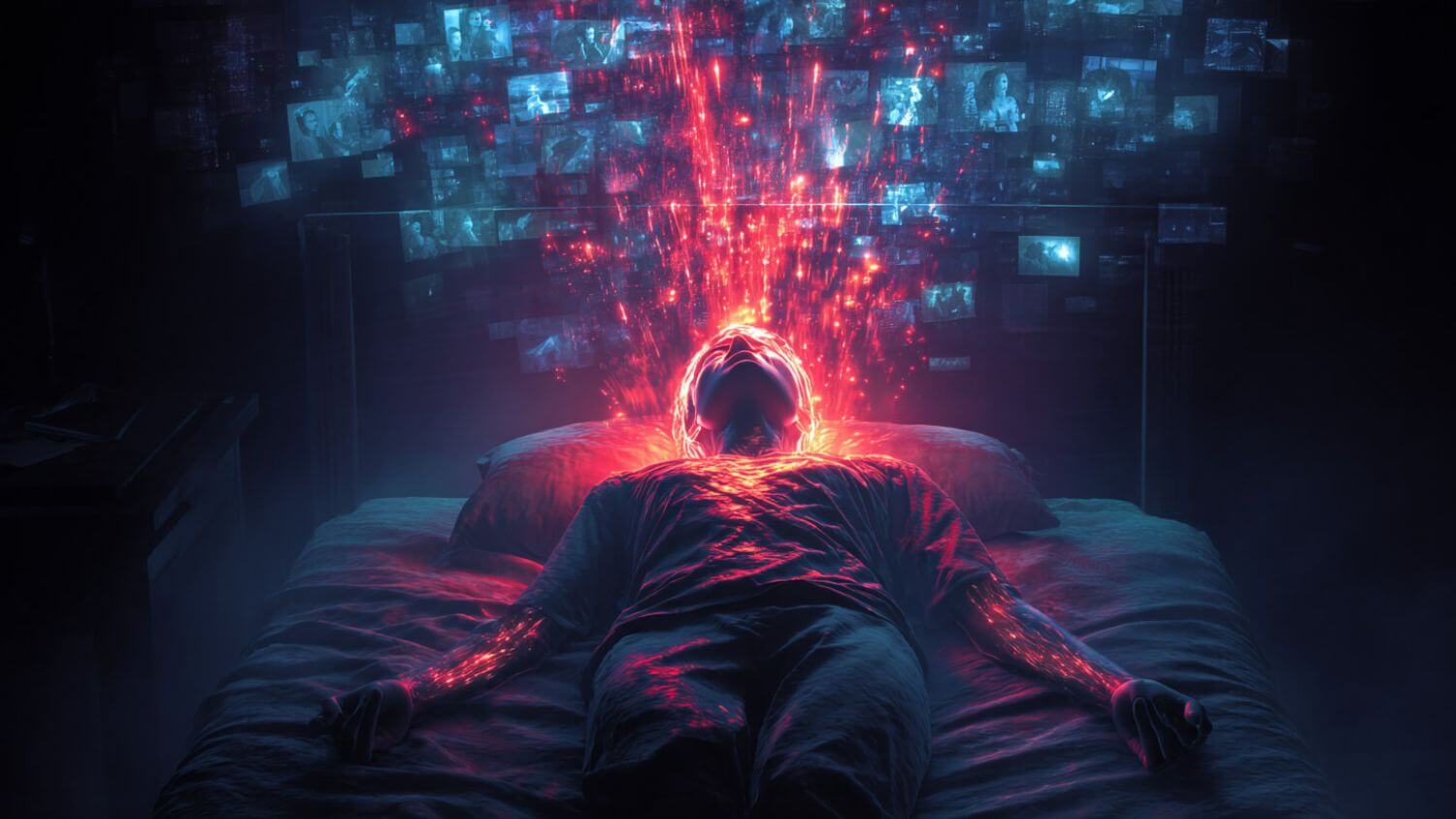
Your brain receives a flood of distress signals. Racing heart. Tight chest. Churning stomach. Shallow breathing. Cold skin. It registers all of it. And it does what brains do. It looks for a story to explain the feeling.
It scans the room. Nothing there.
It scans the body. Pain. Tightness. Dread. But no context.
So it scans your life.
And because the amygdala appears to be running without full supervision, because the part that could say "this is an old signal, this is not current, you are safe" seems to be largely offline, it grabs the first open wound it can find. The shame you carry about something you said. The fear about something you can't control. The regret about a choice you can't unmake.
And it presents it to you as truth.
This. This is why you feel this way. This is real. This is what your body is trying to tell you.
But the research suggests it may not be telling you anything about your life right now. It may be telling you that there's a signal in your tissue that never got resolved. That your fascia may still be braced. That your nervous system may still be cycling through a survival state it entered a long time ago. And that the rational part of your brain, the only part that could put this in context, appears to have powered down for the night.
Those 3 AM "revelations" may not be insight. They may be a panicking interpreter assigning meaning to a signal that it cannot decode.
The shame feels true because your body may be producing the exact chemistry of shame. The dread feels true because your amygdala appears to be generating the exact neurology of real danger. But the cause may not be the story your brain is telling. The cause may be older. Deeper. Written in tissue, not thought.
Why This Matters
This article is not going to tell you what to do at 3 AM.
That's deliberate.
Because the whole point of what you've just read is that the 3 AM brain is not the brain you solve problems with. The tools you'd normally reach for, reasoning, perspective, and self-talk, rely on a prefrontal cortex that research suggests is largely offline at that hour. The night is not the place where this work gets done.
But understanding what's happening may change your relationship to it.
There is a difference between waking up at 3 AM and thinking "something is deeply wrong with me" and waking up at 3 AM and thinking "I know what this is." The feeling might not change. The dread might sit exactly where it always sits. But the meaning shifts. You stop being the defendant in a trial, and your own brain is running. You start being someone who recognizes the machinery.
That recognition is not a cure. It's not a technique. It's a shift in understanding. And for many people, it's the first time the loop cracks even slightly.
The deeper work, the work of changing the broadcast, of helping tissue that reorganized under threat begin to reorganize under safety, of helping a nervous system that locked into survival find its way back, that's the work of daylight. That's the work you do with someone who understands the nervous system. Not alone. Not at 3 AM. Not by thinking harder.
But knowing what the machine is doing, seeing it clearly, understanding that the worst thoughts you've ever had about yourself may have originated in your tissue and not in truth, that is the first fracture in the loop.
Not because it stops the feeling.
Because it separates you from the story.
One More Thing
Everything you just read explores what might be waiting for you when you wake up at 3 AM. Why might it always be the same wound? Why does it feel so true? Why reasoning with it may be the one thing your brain is least equipped to do at that hour.
But there's a question this doesn't answer.
Why that hour? Why does your body seem to choose 3 AM to open the archive? What is happening in your blood chemistry at that specific moment that might make the whole system detonate?
That answer is hiding in your biology. In your adrenal glands. In your blood sugar. In a chemical sunrise you've probably never been told about.
And it changes everything.
▶ Watch: Why You Wake Up Panic-Stricken at 3:00 AM
This is The Anxiety Enigma. We make the invisible visible. We turn the things that haunt you into things you understand.
The night is not what you think it is.
OVERTHINKING
- $49 or 4 monthly payments of $14
30-DAY OVERTHINKING DETOX
- $19
The Off Switch
SLEEP
- $37 or 4 monthly payments of $10
The Deep Sleep Method
Subscribe to the Menty Blog
Tools and tips to keep anxiety from running your life.