Tired But Wired: Why You're Exhausted All Day But Wide Awake The Second You Get Into Bed
You know what's coming tonight. You already know.
You've been barely holding it together since lunch. Your eyes sting. Your body is heavy in a way that sleep should fix, but never does. Someone talked to you twenty minutes ago, and you're not entirely sure what they said. You nodded. You think you nodded.
All day, one thought has been pulling you forward like a rope through fog: I just need to get to bed.
Bed is the finish line. Bed is where this ends. Bed is the one place where your body will finally get what it's been screaming for since you dragged yourself upright this morning.
So you make it. You brush your teeth on autopilot. You pull the covers up. You close your eyes.
And within thirty seconds, you feel it.
Something shifts. Not in the room. In you. A hum that starts behind your ribs and spreads upward. A tightness in your chest that wasn't there when you were on the couch five minutes ago. Your jaw is clenching. Your legs feel restless. And your mind, the same mind that couldn't remember a grocery list three hours ago, is suddenly generating thoughts at a speed that would be impressive if it wasn't destroying you.
The email. The money. That conversation from last week. Whether you locked the door. What you're doing with your life. Whether people actually like you or are just being polite. The weird pain in your side that's probably nothing, but what if it isn't? And then a thought about tomorrow. And then a thought about the thought you just had.
You were a zombie at dinner.
Now you're the most alert human being on the planet.
And somewhere in the dark, a quiet, exhausted voice in your head asks the same question it always asks.
Why does this happen to me?

This is not about discipline. And it's not about your phone.
Let's get something out of the way.
You've heard the advice. You've probably tried most of it. Put the phone down an hour before bed. No caffeine after 2 PM. Make the room cooler. Try magnesium. Try melatonin. Try a weighted blanket. Try journaling before bed. Try breathing exercises. Try not trying.
Some of it helped a little. Most of it didn't. Not because the advice was wrong, but because it was answering a question you weren't asking.
You weren't asking how to optimize your sleep routine. You were asking why your body does the opposite of what it needs the moment you give it the chance to rest.
That's a completely different question. And it has a completely different answer. One that nobody mentions in those "10 tips for better sleep" articles. Because it's not about habits. It's not about screens. It's about something much deeper going on. Something your body is doing on purpose, even though it feels like sabotage.
We'll get there. But first, I need you to see something about your day that you've probably never considered.
The exhaustion was never about doing too much
Here's what your day actually looked like today. Be honest.
You woke up already behind. Not physically behind. Emotionally behind. Before your feet touched the floor, some part of you had already scanned the day ahead and decided it was too much. Not with panic. Not dramatically. Just a quiet, grey weight that settled on your chest before you fully opened your eyes.
You got through the morning. You probably don't remember most of it. Coffee helped, but not really. It just turned the volume down on the heaviness for an hour before it crept back. You did some things. Answered some messages. Sat in front of a screen. Maybe you were productive, maybe you weren't. Either way, by early afternoon, the fog rolled in.
Not sleepy exactly. Something thicker than sleepy. Like your brain was running through wet cement. Words came slower. Focus became a joke. You caught yourself reading the same line three times and absorbing nothing. You walked into a room and stood there, blank, because the reason you got up had already evaporated.
And the worst part? You couldn't point to why. You didn't run a marathon. You didn't do physical labor. Some days, you barely move from the couch. So where did all your energy go?
This is the part that quietly eats you alive. Because when you're this tired, and you can't explain it, you start making up the explanation yourself. And the stories you tell yourself are never kind.
I'm lazy. I'm weak. Other people handle way more than this, and they're fine. There's something fundamentally wrong with me.
None of that is true. But it feels true when you're lying there at 4 PM, unable to bring yourself to do the dishes, watching everyone else apparently move through life without this invisible weight pulling them down.
The energy went somewhere. Somewhere real. And when you finally understand where, the guilt starts to loosen. Because you realize you were never doing "nothing." Your body was doing something incredibly demanding. You just couldn't see it. Nobody around you could see it. And because nobody could see it, you assumed it wasn't happening.
It was happening. Every second of the day.
The video at the end of this article will show you exactly what's been burning through your fuel all day, invisibly, while you sat still and blamed yourself for being tired.
But there's still the night to talk about. Because the night is where this stops making any sense at all.
The switch
Here's the thing nobody can explain to you. Not your partner. Not the person on the podcast who said "just meditate."
If you're this exhausted, why doesn't sleep come?
Tiredness is supposed to lead to sleep. That's one of the most basic equations in biology. Your body needs rest; it shuts down, and you sleep. Cause and effect. The simplest deal in the world.
But every night, your body breaks that deal. And it breaks it at the exact same moment. The second the lights go off and everything goes quiet.
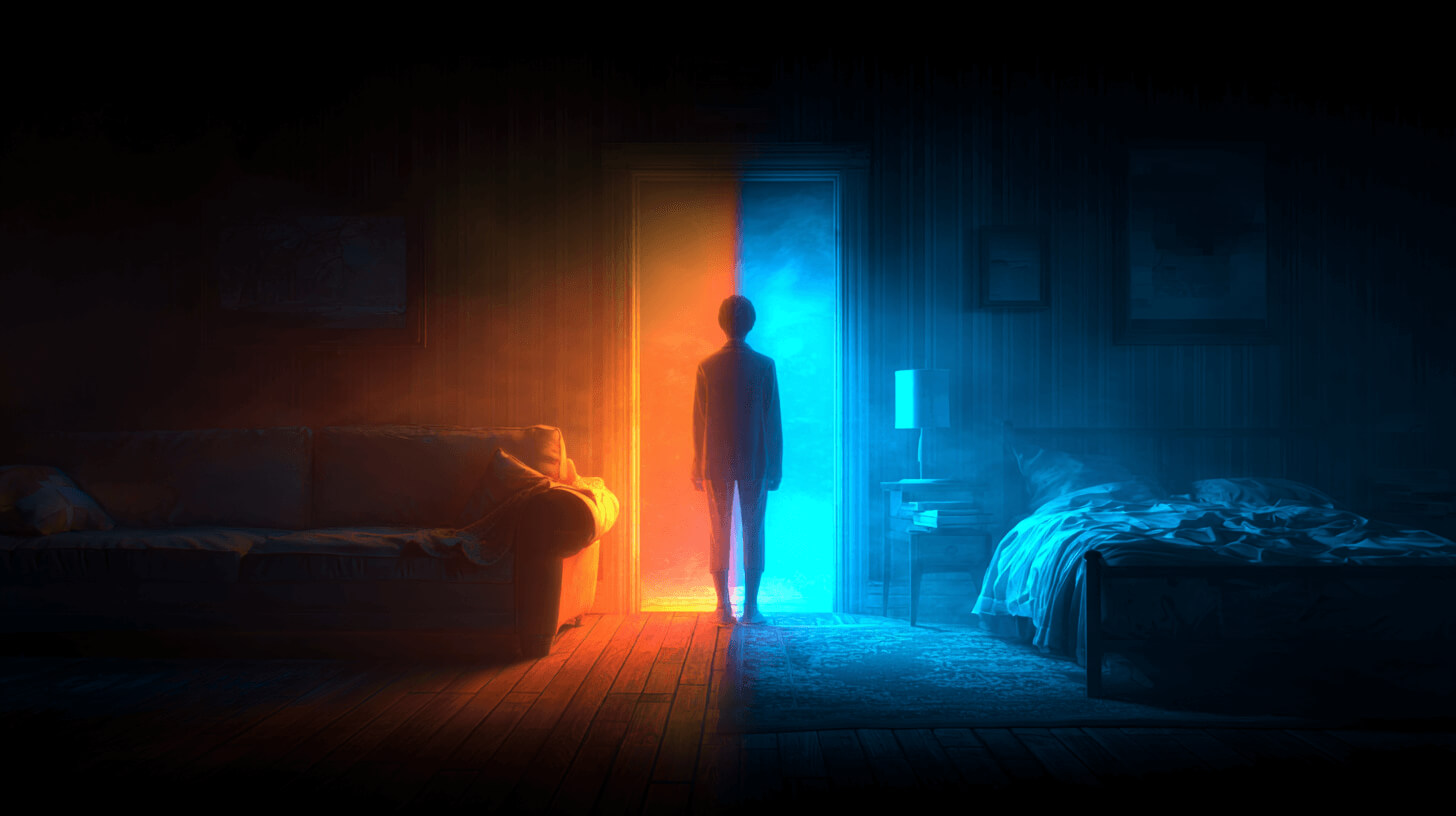
Pay attention to the timing. This isn't random. It's not that you "can't sleep." It's that something that activates the moment your environment changes. You go from the couch, where the TV was on, the lights were on, maybe someone else was in the room, to the bed. Dark. Silent. Alone with yourself.
That transition is where it happens. Every single time.
On the couch, you were drifting off. In bed, you're wired. Same body. Same level of exhaustion. The only thing that changed is the environment around you. Something about the darkness, the silence, and the aloneness flips a switch inside you that has nothing to do with how tired you are.
Your body is saying shut down. Something else inside you is saying absolutely not.
And you're caught between the two. Too tired to get up. Too wired to fall asleep. Just stuck. In the dark. With every thought you managed to avoid during the day, now standing at the foot of your bed, waiting for your full attention.
Why "just relax" makes it worse
So you do the logical thing. You try to calm down.
You take slow breaths. You try to empty your mind. You tell yourself the thoughts aren't real, the worries can wait until morning, everything is fine, just let go.
And your mind responds by thinking louder.
You try harder. You change positions. You flip the pillow to the cool side. You do the breathing thing again. In for four, hold for seven, out for eight. You're doing everything right.
It's getting worse.
This is the part that makes people feel like they're losing their minds. Because you're trying to do the right thing and it's backfiring. The more effort you put into falling asleep, the further sleep gets. Like reaching for something in water. The harder you grab, the more it slips.
There's a reason for this. A real, specific reason that has nothing to do with you doing it wrong.
The act of trying to sleep is itself an effort. Effort is alertness. Alertness is the opposite of surrender. And sleep only comes through surrender. So every time you try harder, you're asking your brain to work hard at not working. Push harder at letting go. Force yourself into softness.
It can't do both. And the frustration you feel when it doesn't work? That frustration is just another layer of alertness. Another reason your body decides this is not the moment to shut down.
The trap tightens every time you pull against it. And the person stuck inside it isn't doing anything wrong. They're just caught in a mechanism they've never been taught to see.
The question nobody is asking
Every article about sleep asks the same question: how do I fall asleep?
Wrong question.
The right question, the one that changes everything, is this: why does my body believe it's dangerous to fall asleep right now?
Because that's what's actually happening. Not consciously. You're not lying there thinking, "sleep is dangerous." But somewhere underneath your thoughts, underneath your awareness, a part of you is running a very old calculation. And the answer it keeps arriving at is: not safe. Don't shut down. Stay alert. Something might happen.
It doesn't know what. It doesn't need to know what. It just knows that the conditions around you, dark, quiet, and alone, do not meet its requirements for safety. So it does its job. It keeps you awake.
And here's the cruelest part of all. It waited until bedtime to do it. All day, while you were surrounded by noise and light and people and distraction, it stayed quiet. It lets you be exhausted. But the moment you actually needed to use that exhaustion, the moment you created the conditions for sleep, it stepped in and said no.
Not to punish you. Not because you're broken. Not because you need a better pillow or a different supplement.
For a reason. A reason that's older than you can imagine. Wired into you before you were born. And once you understand it, once you actually see why your body does this, something shifts. Not the kind of shift where everything magically gets better overnight. The kind where you stop fighting yourself. Where the question changes from what is wrong with me to something far more useful. Something that opens a door instead of slamming one shut.
This is where the story turns
I could explain the full mechanism here. I could walk you through what's happening inside you when the switch flips, what your body is actually protecting you from, and why this whole experience is not a malfunction but something far stranger and far more human than you've ever been told.
But some things land differently when you hear them. When someone walks you through it slowly and you feel the recognition build. That moment where all the scattered pieces, the daytime fog, the nighttime wiring, the heaviness, the guilt, the frustration, suddenly click into one pattern. One thing. Not ten separate problems. One.
That moment is in the video below.
Watch it. Not for tips. Not for a quick fix. Watch it because you deserve to finally understand what's been happening to you, probably for longer than you realize. And because once you see the pattern, you can't unsee it.
That's where everything begins to shift.
OVERTHINKING
- $49 or 4 monthly payments of $14
30-DAY OVERTHINKING DETOX
- $19
The Off Switch
SLEEP
- $37 or 4 monthly payments of $10
The Deep Sleep Method
Subscribe to the Menty Blog
Tools and tips to keep anxiety from running your life.