The Hidden Difference Between Anxiety and an Anxiety Spiral
Not all anxiety is a spiral. But once it becomes one, everything changes.
Here's what most people don't realize: there's a massive difference between feeling anxious and being caught in an anxiety spiral. One is manageable. The other takes over your entire day.
The problem? Most people can't tell when they've crossed the line. They think it's all just "anxiety," so they keep using the same strategies that worked for normal worry. And those strategies fail.
Because a spiral isn't anxiety. It's a self-sustaining feedback loop. And if you don't know the difference, you'll keep treating the wrong thing.
And here's what you need to know: if you're caught in spirals, your brain isn't broken. It's following a predictable pattern that most people just don't know how to interrupt.
Let me show you how to tell them apart.
Normal Anxiety: A Response
Normal anxiety is your brain responding to a specific stimulus.
What it looks like:
You have a presentation tomorrow and feel nervous
You're worried about a difficult conversation
You feel uneasy about a decision you need to make
A stressful situation makes your heart race
Key characteristic: The anxiety is proportional to the situation and connected to a real, identifiable trigger.
What happens next: Once you address the situation (or it passes), the anxiety fades. You might feel relieved, tired, or just neutral. But it's over.
Normal anxiety has a beginning, a peak, and an end.

An Anxiety Spiral: A Loop
An anxiety spiral is when anxiety becomes self-generating. It's no longer about the original trigger. It's about the anxiety itself.
What it looks like:
Emma sent an email to her boss at 2 PM. At 5 PM, she was still thinking about it, but not about the email anymore. She was thinking about why she couldn't stop thinking about the email. Why was she like this? What was wrong with her? That's when her normal anxiety became a spiral.
Here's what that looks like:
You're anxious about a presentation, then anxious that you're anxious, then anxious that you can't stop being anxious
A small worry triggers a body response, which triggers more worry, which triggers a stronger body response
You've completely lost track of what started this, you're just... spiraling
The anxiety feels bigger than the original problem
Key characteristic: The anxiety feeds itself. Mind triggers body. Body triggers mind. And it accelerates.
What happens next: The spiral doesn't end when you "solve" the original problem. It ends when you run out of fuel and crash into exhaustion, sometimes hours later, sometimes the next day, leaving you depleted and confused about what just happened.
An anxiety spiral has a beginning, but no natural end. It just loops until your system burns out.

The Tipping Point: When Anxiety Becomes a Spiral
So when does normal anxiety cross into spiral territory?
The exact moment it becomes a spiral:
When you stop thinking about the problem and start thinking about the fact that you're thinking about the problem.
Read that again.
Normal anxiety: "I'm worried about this presentation."
Spiral: "Why can't I stop thinking about this presentation? What's wrong with me? Why am I like this?"
The shift happens when:
Your anxiety becomes the threat, not the original trigger
Your body starts reacting to your thoughts, not the situation
You're trying to think your way out, but thinking makes it worse
You feel trapped inside your own mind
That's the tipping point. And once you cross it, you're in the loop.

How to Recognize You're in a Spiral (Right Now)
Ask yourself these questions:
Are you thinking about the original problem, or about your anxiety?
If you're thinking: "I can't stop thinking," you're in a spiral.
Is your body reacting even though nothing external has changed?
If your heart is racing but you're just sitting there, you're in a spiral.
Are you anxious about being anxious?
If you're worried that you're worrying, you're in a spiral.
Have you lost track of what triggered this?
If you don't remember what started it, you're in a spiral.
Does solving the "problem" not make the anxiety stop?
If nothing you do makes it better, you're in a spiral.
If you answered yes to two or more, you're not dealing with normal anxiety. You're in a loop.
And if you just felt a wave of relief reading this, that's normal. You're not losing your mind. You're in a pattern. And patterns have exits.

Quick Interrupt: What to Do Right Now
The moment you realize you're spiraling, try this:
Name it out loud: "This is a spiral."
That's it. Just label it.
That simple act of naming creates distance between you and the loop. It won't solve the spiral, but it can pause the acceleration long enough for you to apply a real interruption strategy.
Think of it as hitting the pause button, not the stop button.
Why this works: The second you label what's happening, you shift from being in the experience to observing the experience. That shift breaks the automatic momentum, even briefly.
Try it next time you catch yourself spiraling. You'll feel the difference.

Why This Matters
When you mistake a spiral for normal anxiety, you try to solve it with logic. You try to think your way out. You analyze the problem harder.
But spirals don't respond to logic. They respond to pattern interruption.
Normal anxiety asks: "What do I do about this situation?"
A spiral asks: "How do I stop this loop?"
Different problem. Different solution.
What to Do When You Recognize the Spiral
The moment you realize you're in a spiral, not just feeling anxious, everything changes.
Because now you're not trying to solve the problem your brain is obsessing over. You're trying to interrupt the loop.
And that requires understanding what the loop actually looks like.
The spiral has a structure. Predictable phases. Specific points where it can be interrupted.
Most people never learn this. They stay stuck in the same pattern for years, thinking they just need to "manage their anxiety better."
But once you see the pattern, you can stop it before it takes over.
See the Complete Pattern
This article showed you the difference between anxiety and a spiral. That awareness alone changes everything.
But understanding you're IN a spiral is just the first step.
The spiral follows five predictable phases. Each phase has specific characteristics. And there are three critical windows where you can interrupt the loop before it gains momentum.
I've mapped out the complete anatomy; the exact sequence it follows every time, where the feedback loop gains power, and precisely where you can break it.
→ Watch the free training:
It breaks down all 5 phases and shows you exactly where the loop can be stopped.
Want the visual guide?
Download the printable reference: Anatomy of an Anxiety Spiral with all phases mapped out and a quick-reference card you can use in the moment.
Ready to train the skill of interrupting spirals before they take over?
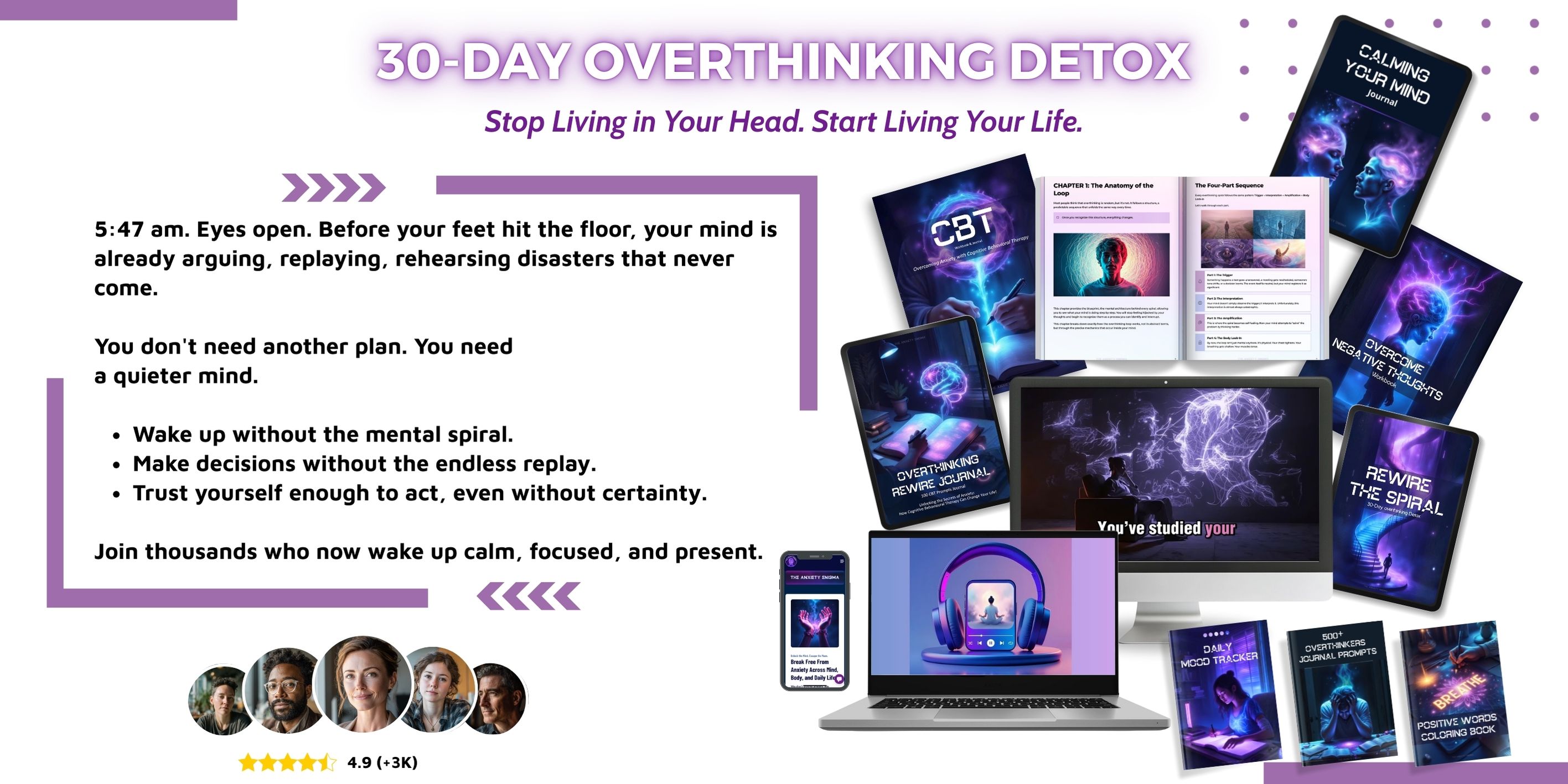
The 30-Day Overthinking Detox teaches you how to catch spirals early and rewire your response through daily practice.
You're Not Broken. You're In a Loop.
And loops can be broken.
You just need to know where to apply pressure.
Now you do.
OVERTHINKING
- $49 or 4 monthly payments of $14
30-DAY OVERTHINKING DETOX
- $19
The Off Switch
SLEEP
- $37 or 4 monthly payments of $10
The Deep Sleep Method
Subscribe to the Menty Blog
Tools and tips to keep anxiety from running your life.